Canada records 60% fall in new international student arrivals
New federal data has revealed another year of declining international student number in Canada, as stakeholders warn of waves of program closures and layoffs across Canadian institutions.
On top of the 61% fall in new student arrivals, the new IRCC data revealed a 30% decrease in total study permit holders (including those who also hold a work permit), falling from roughly 995,000 to 690,000 students from December 2023-2025.
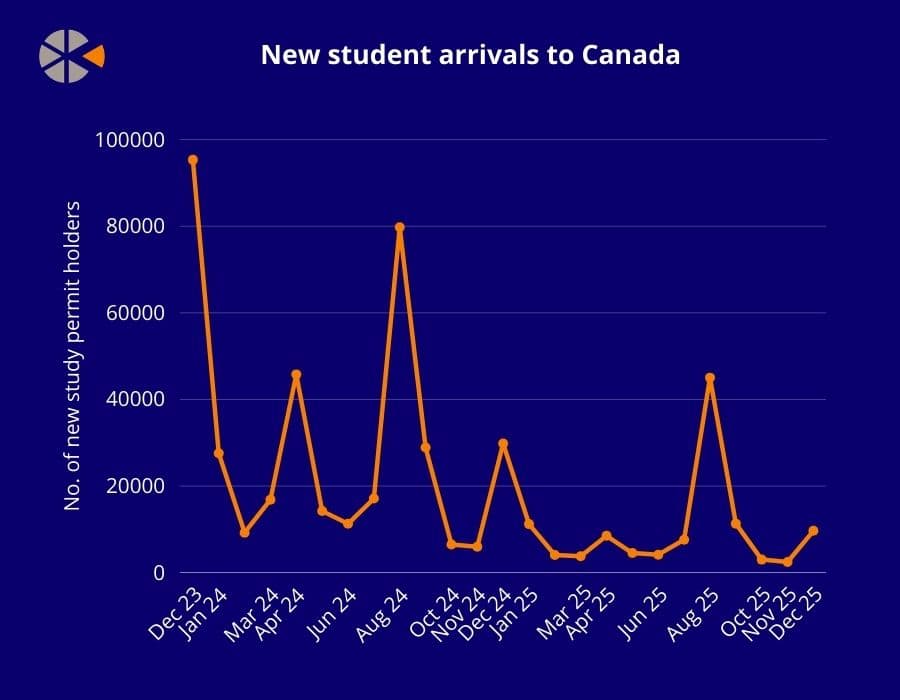
Annual spikes in December and August reflect seasonal peaks in the issuance of study permits before the start of the winter and fall semesters.
During this time, policy changes have plagued the Canadian sector, most notably the federal study permit caps, announced in January 2024 and further reduced in 2025 and 2026.
Visa processing delays and plummeting approval rates have only worsened the situation, with sector leaders once again sounding the alarm over immediate sector harm and long term consequences for Canadian labour markets.
“Some institutions are feeling these impacts more acutely than others. Institutions are continuing to face significant budget pressures and subsequent waves of program closures and layoffs,” CBIE president Larissa Bezo told The PIE News.
In more extreme cases, entire campuses or institutions have shut down, including most recently the Manitoba Institute of Trades and Technology (MITT) – the first public post-secondary institution to close after a 55% international enrolment decline this year.
More broadly, Bezo said the loss of international talent, and the consequential reduced capability of institutions to offer programming to domestic students, would have “significant consequences” for Canada’s regional and national labour markets.
“We must ensure that Canada’s sovereignty and future prosperity is not undermined by a lack of talent, both domestic and international, nor limited capacity to train the Canadian workforce of the future,” said Bezo.
She added this was especially vital given Canada’s scaling up of its “nation-building” agenda announced in the 2025 budget, involving major infrastructure and housing projects, emphasising economic self-reliance and reducing dependence on the US.
We must ensure that Canada’s sovereignty and future prosperity is not undermined by a lack of talent
Larissa Bezo, CBIE
Notwithstanding the dire challenges facing Canadian international education, the 2025 budget included a welcome CAD$1.7bn investment in attracting global research talent, as the government exempted graduate students from this year’s caps.
What’s more, Bezo said the policy turbulence had shone a light on the “chronic underfunding” of post-secondary education (PSE) in Canada, with declining international numbers exposing decades of underfunding and tuition freezes from the provinces.
Accordingly, provincial governments have started focussing on the issue in recent months, with British Columbia launching a public review into the long-term sustainability of its post-secondary system and Ontario recently investing $6.4bn in the sector.
Despite some positives signals, international education remains largely at the mercy of Canadian domestic politics. With rising anti-immigration sentiment across several of the leading study destinations, the government has vowed to return immigration to “sustainable levels”, aiming to reduce Canada’s temporary residents to less than 5% of the total population.
The IRCC said the recent declines in international students were “a clear sign that the measures [it] put in place are working”, reflecting its “commitment to a well-managed and sustainable immigration system”.
The post Canada records 60% fall in new international student arrivals appeared first on The PIE News.